How we publish
Editorial policy
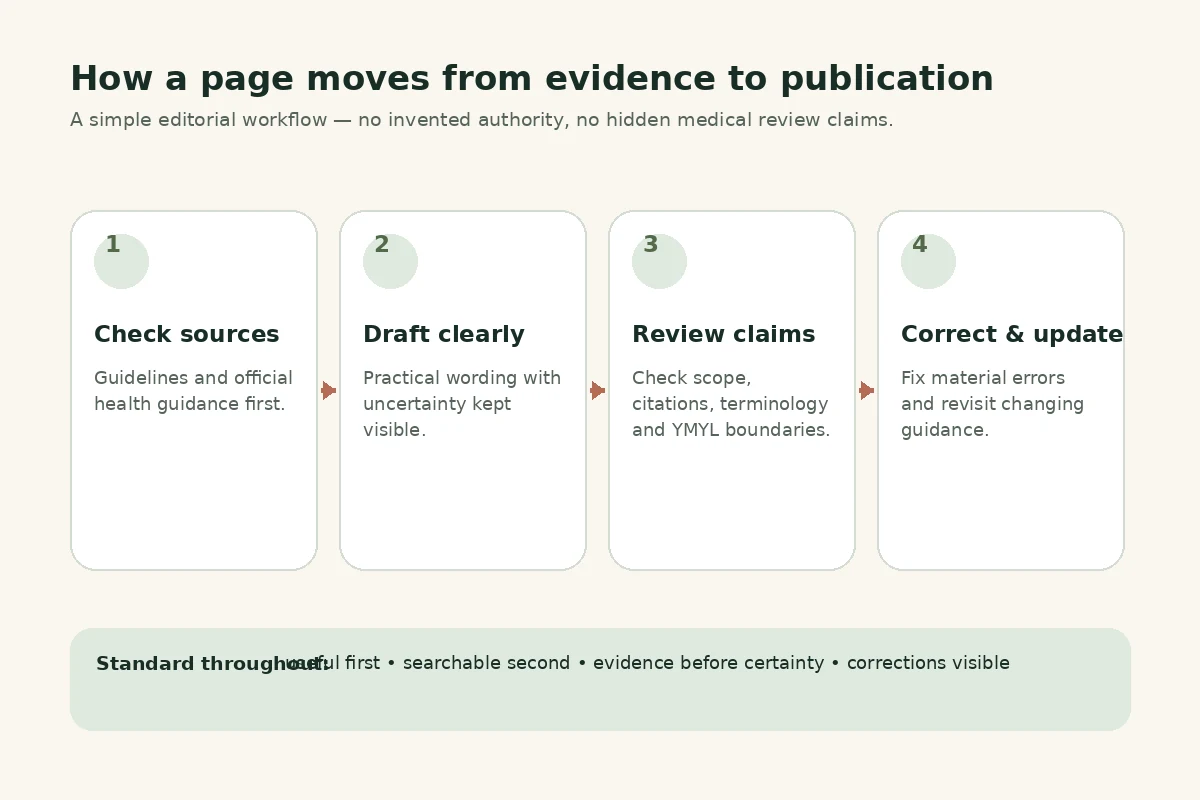
Health content deserves a higher bar than ordinary lifestyle copy. These rules govern how we research, write, update and correct Fatty Liver Meal Planner content.
1. Useful first, searchable second
Every page must answer a genuine reader need. Search demand can help us decide which questions deserve pages, but it does not justify thin, repetitive or exaggerated medical content.
2. Evidence before certainty
We prioritise current clinical guidelines, NHS and UK government guidance, systematic reviews and high-quality primary research. A claim becomes stronger because the evidence is stronger — not because a headline sounds confident.
Where evidence is observational, mixed, indirect or preliminary, the wording must make that limitation clear.
3. Practical food content without personalised treatment
Recipes and meal plans are examples designed to make broad healthy-eating guidance easier to use. They are not prescriptions and are not tailored to an individual's liver disease stage, diabetes treatment, kidney function, allergies, medication, energy needs or other clinical circumstances.
4. No fabricated authority
We do not invent authors, clinicians, dietitians, medical-review boards, patient stories, testimonials, ratings, clinical partnerships or professional endorsements. If expert review is added later, the reviewer, credentials, scope and review date must be real and clearly stated.
5. Terminology and changing guidance
Medical terminology changes. MASLD is the newer term for the condition previously widely called NAFLD. We may use both terms where doing so helps readers find and understand current information. Material guidance changes trigger review of affected pages.
6. Commercial separation
Advertising, if added, must not determine our health conclusions. Sponsored or affiliate relationships must be clearly disclosed if they ever exist. We do not use supplement promotion as evidence and we do not design health claims around advertiser interests.
7. Updates and corrections
Substantive health pages should display a review/update date. When evidence changes or a material factual error is found, we update the page and follow our Corrections policy.
8. Reader safety
We do not publish diagnostic calculators, fibrosis scoring tools, drug-adjustment advice, emergency triage or personalised treatment recommendations as casual consumer tools. Where a question belongs with a clinician, we say so.