NHS: NAFLD / MASLD
The NHS overview explains the condition, recognises MASLD as the newer name, and emphasises healthy lifestyle changes including a balanced diet, physical activity and weight management where appropriate.
View NHS sourceHow we decide what to trust
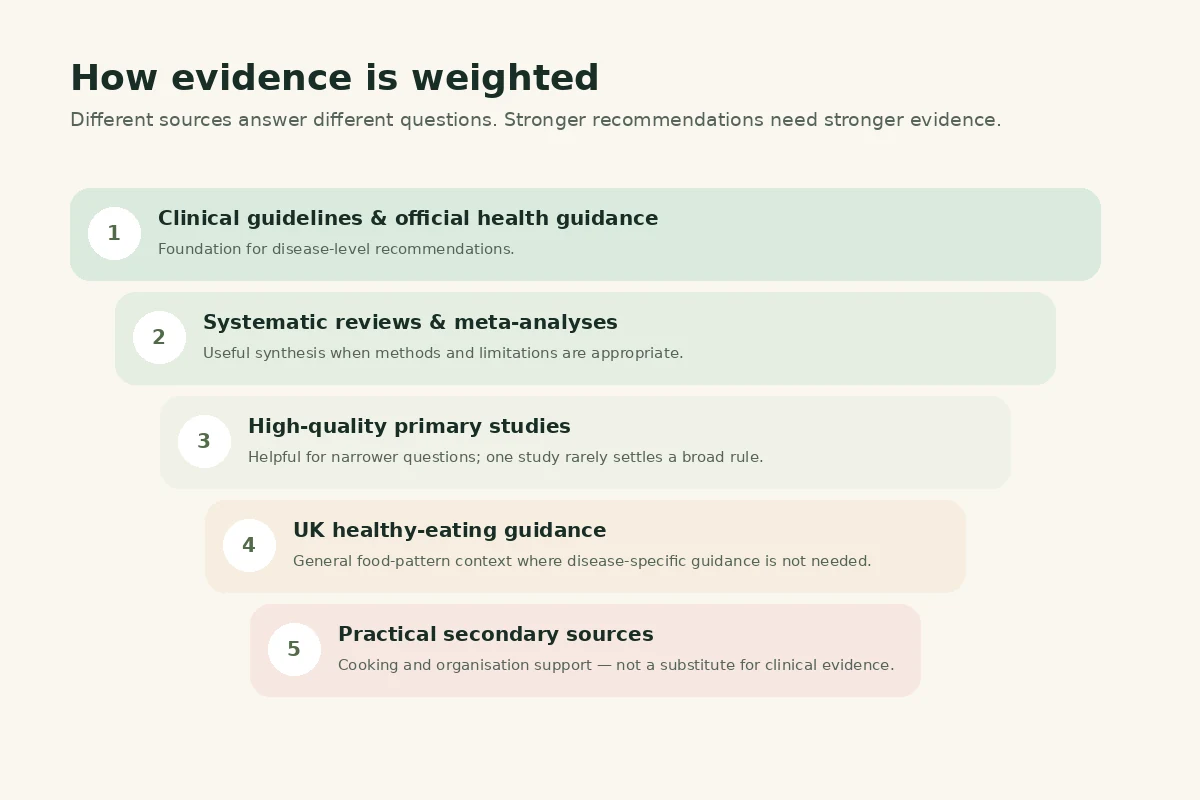
Not all sources answer the same question or carry the same weight. We use an evidence hierarchy and make uncertainty visible instead of flattening every study into a “good” or “bad” food rule.
The NHS overview explains the condition, recognises MASLD as the newer name, and emphasises healthy lifestyle changes including a balanced diet, physical activity and weight management where appropriate.
View NHS sourceThe 2024 joint European clinical practice guideline provides the current evidence framework for MASLD, including non-pharmacological management and dietary-pattern recommendations.
View guidelineThe Eatwell Guide defines UK government healthy-eating recommendations and is used for general balanced-diet context rather than as a disease-specific treatment plan.
View GOV.UK sourceA food can fit into an overall healthy eating pattern without having proven liver-specific benefits. We therefore avoid turning associations into prescriptions. If research on coffee, eggs, fruit, dairy or another food is uncertain or observational, the page should say that rather than announcing the food “heals”, “cleanses” or “reverses” fatty liver.
We favour current guidance and check whether older evidence has been superseded. A source being old does not automatically make it wrong, but major changes in terminology, treatment or dietary guidance trigger a fresh evidence check.