Free weekly planner

Build a practical 7-day meal plan.

Choose a broad eating pattern and how much cooking time suits you. The planner organises seven days of balanced meal ideas — without calorie targets, disease scoring or claims to prescribe a medical diet.

Important: this is a general planning aid for adults, not personalised medical or dietetic advice. If you have diabetes, kidney disease, food allergies, eating-disorder concerns, are pregnant, or have other dietary needs, get individual advice from an appropriate healthcare professional.
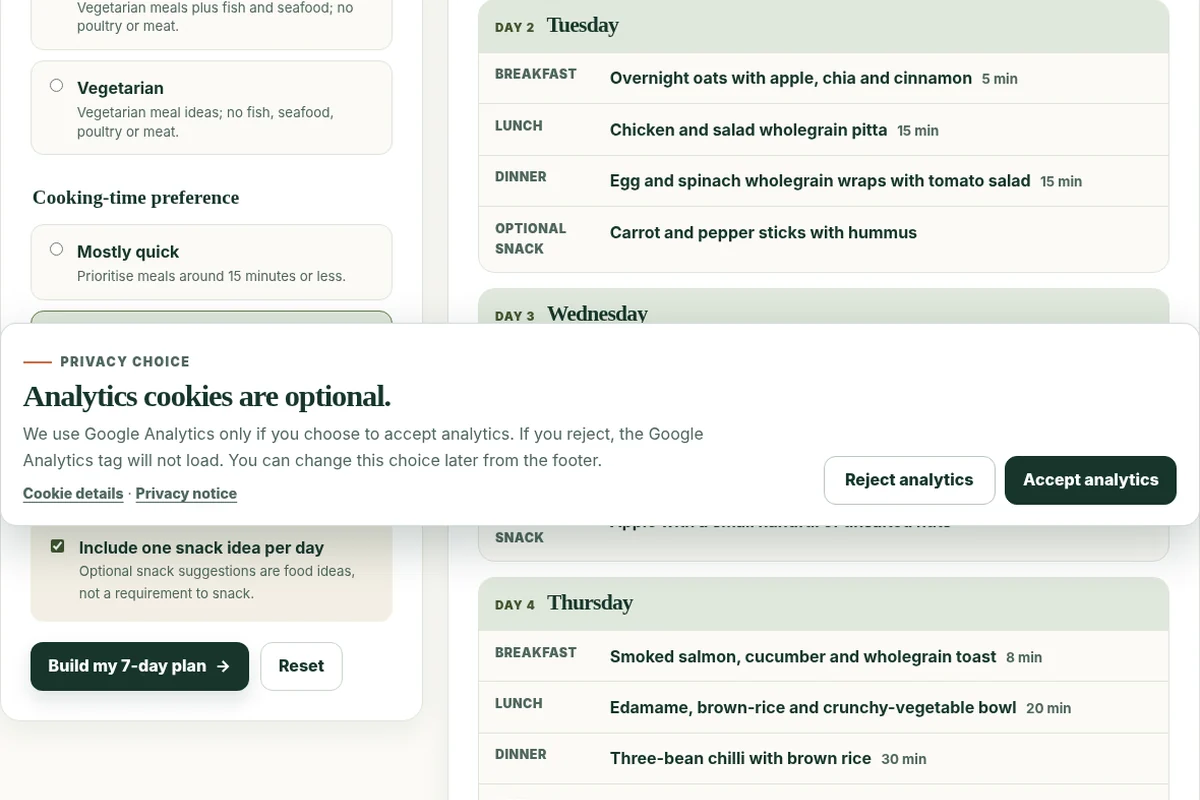
The seven-day Meal Planner interface with editable meal-planning controls.
The seven-day Meal Planner interface with editable planning controls.

1 · Set your preferences

Make the week fit real life

Preferences change which meal ideas are included. They do not assess your medical needs.

Eating pattern
Cooking-time preference

2 · Your week

Your plan will appear here.

Choose your preferences, then build the plan. You can regenerate it for a different mix using the same settings.

How to use it

A plan is a starting point, not a prescription.

The planner is designed to reduce the blank-page problem of deciding what to eat. Swap meals to suit your normal food, budget, culture and appetite. Portion needs vary substantially between people, so the tool deliberately does not assign calories or gram targets.

If your clinician or dietitian has given you specific advice — for example because of diabetes, kidney disease, medicines, allergies or another condition — that advice takes priority over this general planner.

Why the suggestions look Mediterranean-style

Current European MASLD guidance recommends improving overall diet quality in a direction similar to a Mediterranean dietary pattern, while limiting ultra-processed foods rich in sugars and saturated fat and avoiding sugar-sweetened drinks.

That does not mean there is one mandatory “fatty liver diet”, nor that a Mediterranean-style meal is a treatment on its own.

Evidence basis

What this planner is — and is not — based on

NHS

The NHS advises a healthy, balanced diet, regular physical activity and weight management where appropriate for NAFLD/MASLD.

Read NHS guidance

EASL–EASD–EASO guideline

The 2024 European guideline recommends improved diet quality similar to a Mediterranean dietary pattern, less ultra-processed food rich in sugars and saturated fat, and avoiding sugar-sweetened beverages.

Read the clinical guideline

NIDDK

NIDDK describes healthy eating, portion awareness, replacing saturated/trans fats with unsaturated fats and limiting foods and drinks high in simple sugars.

Read NIDDK guidance

Evidence checked: 17 August 2026. See our evidence and sources policy and medical disclaimer.