Free food lookup

See how everyday foods fit the bigger picture.

Search common foods and drinks for practical context on how they generally fit a Mediterranean-style eating pattern used in current MASLD guidance. The lookup avoids simplistic “good” and “bad” labels.

Important: this is general food-quality information, not a personalised diet prescription. Allergies, diabetes, kidney disease, medicines, weight goals and other conditions can change what is appropriate for you.
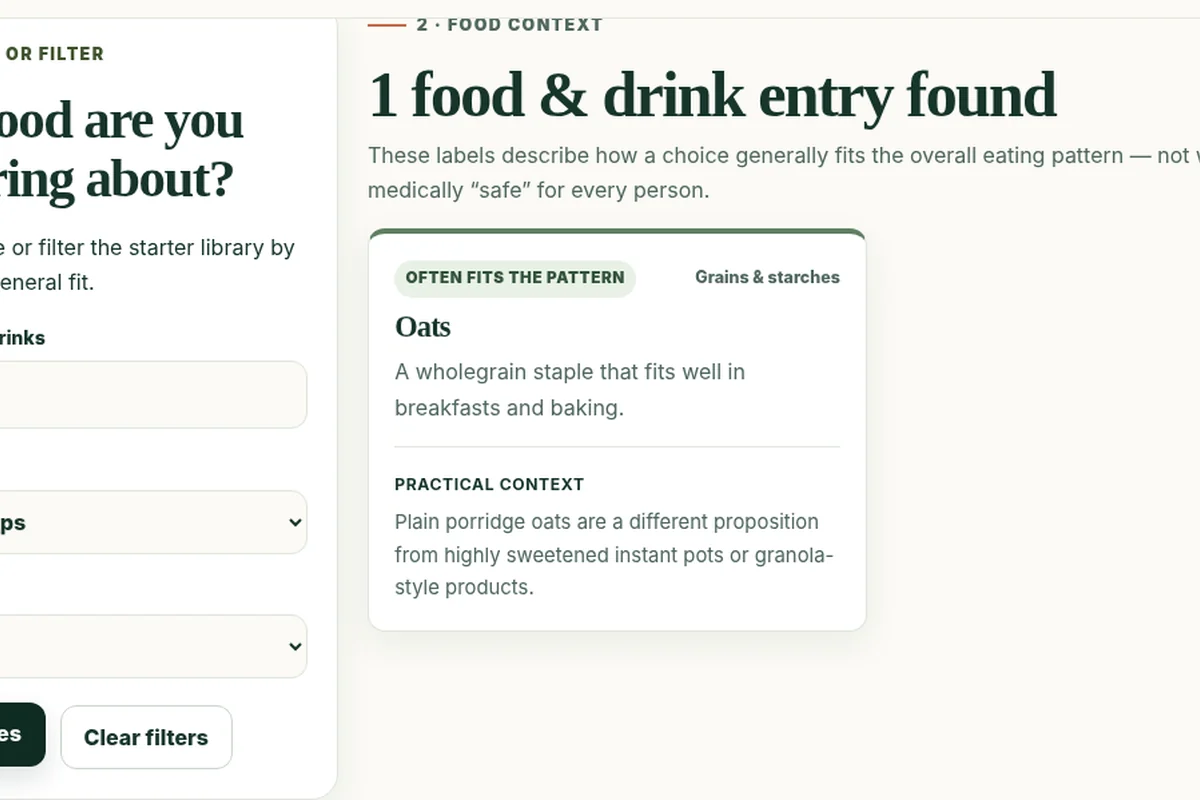
The Food Lookup interface showing a food search and result cards.

1 · Search or filter

What food are you wondering about?

Search by name or filter the starter library by food group or general fit.

2 · Food context

Food & drink entries

These labels describe how a choice generally fits the overall eating pattern — not whether it is medically “safe” for every person.

How to read the results

Look at the form of the food, not just its name.

Whole fruit and fruit juice are not nutritionally identical. A baked potato and chips are not the same choice. Plain yoghurt and a heavily sweetened dessert yoghurt can sit differently in the overall pattern.

That is why this tool gives preparation and label-reading context instead of assigning a permanent score to a food.

Pattern beats perfection

Current European MASLD guidance emphasises improving overall diet quality, with a Mediterranean-style pattern, while limiting ultra-processed foods rich in sugars and saturated fat and avoiding sugar-sweetened drinks.

One meal or ingredient does not define the whole diet.

Evidence basis

What the classifications are based on

EASL–EASD–EASO guideline

The 2024 European guideline describes Mediterranean-style eating as rich in vegetables, fruit, nuts and seeds, legumes, wholegrains, olive oil, fish and seafood, while reducing added sugars, refined carbohydrates, saturated fat, ultra-processed foods and red/processed meat.

Read the clinical guideline

NHS

The NHS advises a healthy, balanced diet alongside other healthy lifestyle changes for people with NAFLD/MASLD.

Read NHS guidance

NIDDK

NIDDK advises replacing saturated and trans fats with unsaturated fats, choosing more low-glycaemic foods such as fruits, vegetables and wholegrains, and limiting foods and drinks high in simple sugars.

Read NIDDK guidance

Evidence checked: 17 August 2026. See our evidence and sources policy and medical disclaimer.