Steatotic liver disease
The newer umbrella term for liver diseases where excess fat (steatosis) is present. SLD can have different causes and subtypes, so it is broader than MASLD alone.
Fatty liver terminology
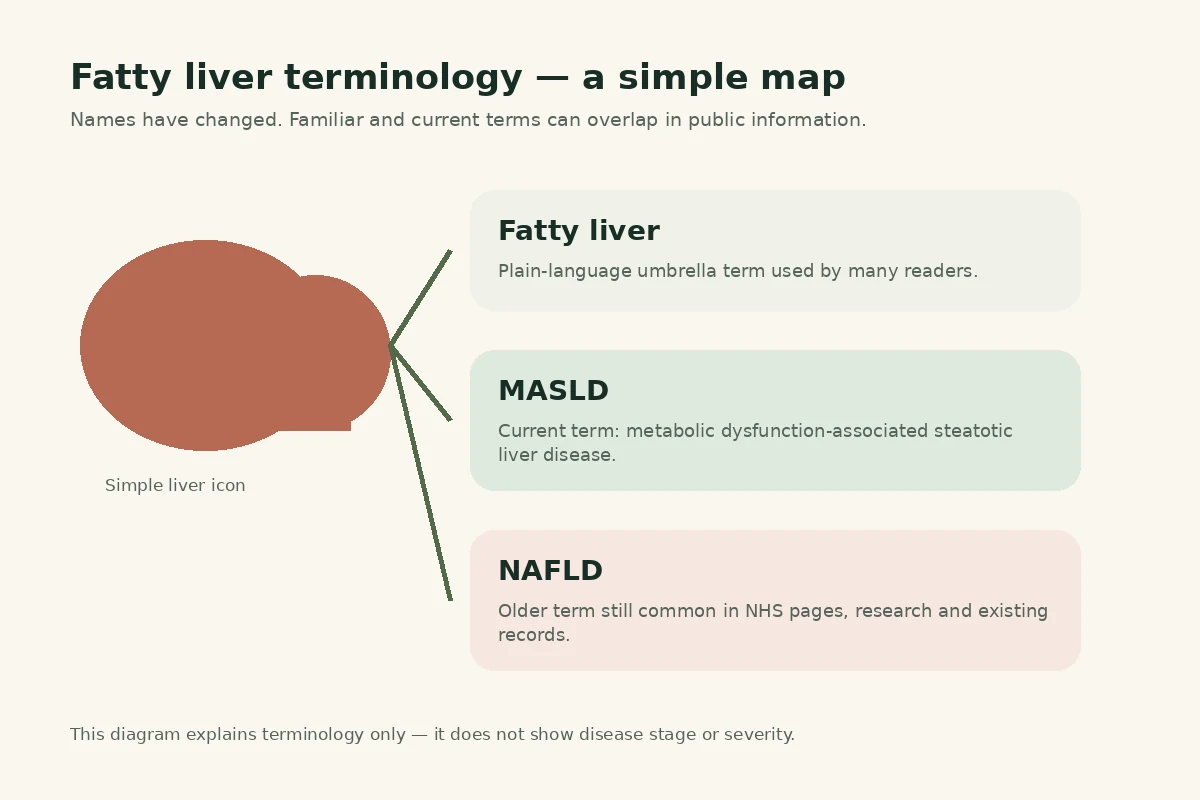
MASLD is the newer medical name for the condition many people still know as NAFLD or “non-alcoholic fatty liver disease”. You may see both terms because the international naming change is recent and health services, medical records and older articles do not all update at the same speed.
This page explains terminology only. A name on a website cannot diagnose your condition or tell you how advanced it is. If your scan, blood tests or clinic letter use unfamiliar wording, ask the clinician responsible for your care what it means in your case.
The quick answer
In June 2023, an international multi-society consensus introduced new terminology for diseases involving excess fat in the liver. The broader umbrella term became steatotic liver disease (SLD). Within that system, metabolic dysfunction-associated steatotic liver disease (MASLD) replaced the older term non-alcoholic fatty liver disease (NAFLD), and MASH replaced NASH.
The change was intended to describe the underlying metabolic context more directly and to move away from defining the condition mainly by what it is not — namely “non-alcoholic”. But the older terms have not disappeared. The NHS still titles its main public page “Non-alcoholic fatty liver disease (NAFLD)” while explicitly stating that it is also known as MASLD. British Liver Trust similarly advises that people may hear both old and new names while the transition continues.
Name map
You do not need to memorise every acronym. These are the ones most likely to appear when reading about metabolic fatty liver disease.
The newer umbrella term for liver diseases where excess fat (steatosis) is present. SLD can have different causes and subtypes, so it is broader than MASLD alone.
The newer term replacing NAFLD. The 2024 EASL–EASD–EASO guideline defines MASLD as steatotic liver disease in the presence of one or more cardiometabolic risk factors, in the relevant clinical context.
The older term still widely used in NHS pages, older research, clinic letters and everyday searches. Current guidance treats the NAFLD evidence base as highly applicable to MASLD because the populations substantially overlap.
The newer term replacing NASH. It describes the inflammatory form within the MASLD spectrum and is not something a meal-planning website can diagnose.
The older name for what is now called MASH. You will still encounter NASH in older medical records, research papers and public information.
A newer category within the SLD system for people who meet metabolic criteria and also have alcohol intake within a defined range. Alcohol history matters clinically, so do not self-classify from a short online description.
Why the terminology changed
The previous name, NAFLD, was largely a diagnosis framed around the absence of significant alcohol use. The newer MASLD name brings cardiometabolic risk factors into the definition and sits within the broader SLD classification.
That matters because MASLD is closely associated with metabolic health. The joint European guideline links it particularly with factors such as type 2 diabetes, obesity, abnormal blood lipids and high blood pressure. The terminology is therefore intended to describe the disease biology and clinical context more positively rather than defining it only by alcohol exclusion.
The change does not mean that everybody previously told they had NAFLD suddenly needs to assume their diagnosis was wrong. The guideline notes very high overlap between populations defined under the older NAFLD criteria and the newer MASLD criteria, which is why earlier NAFLD evidence can still inform MASLD guidance.
Reading health information
Both can be useful. “Fatty liver” and “NAFLD” remain common public search terms, while newer clinical guidance increasingly uses MASLD. A good-quality page should make the relationship clear rather than forcing you to know the newest acronym before you can find help.
Look for MASLD and MASH in recent specialist guidelines and newer NHS materials.
Expect NAFLD and NASH in older research papers, clinic letters and historical diagnoses.
“Fatty liver” remains useful plain English, but it is not precise enough on its own to establish the cause or severity of liver disease.
Names are not stages
It is easy to mistake a new acronym for a severity score. MASLD is a disease category, not a stage number. Within the MASLD spectrum, people can have simple steatosis, MASH, fibrosis or cirrhosis, and those distinctions require appropriate clinical assessment.
The NHS explains that fatty liver is often discovered during tests done for another reason and that further blood tests or imaging may be used to look for liver damage and other causes. The European guideline similarly emphasises fibrosis assessment because fibrosis stage is important for liver-related outcomes.
That is why this website will not offer a “fatty liver severity calculator” or ask you to diagnose MASH from symptoms. Meal planning can support healthy everyday choices, but it cannot establish your stage, rule out another cause of liver disease or replace medical follow-up.
Common questions
The short answers below are designed to reduce confusion, not replace a diagnosis.
MASLD replaced NAFLD in the newer nomenclature and the patient groups overlap very strongly, but the formal definitions are not literally identical. MASLD positively requires a cardiometabolic risk factor within the new SLD framework.
MASH is the newer name replacing NASH within the metabolic steatotic liver disease terminology. You may still see NASH in older records and research.
No. Fat accumulation in the liver can occur for different reasons. SLD is the broader umbrella and clinicians consider metabolic factors, alcohol and other possible causes.
A terminology change alone is not a reason to self-diagnose or reclassify yourself. If your records use NAFLD/NASH and you want to know how the newer terminology applies, ask the clinician responsible for your care.
From terminology to action
This page owns terminology intent. The pages below handle eating patterns, food choices and planning rather than repeating the acronym explanation.
Start with the broad evidence-led eating pattern and practical food priorities.
See how current dietary guidance translates into ordinary meals without creating rigid food rules.
Explore practical food groups and examples that fit the wider pattern.
Organise general meal ideas into a week without turning the output into a medical prescription.
Evidence checked 17 August 2026
See our editorial policy, evidence policy and medical disclaimer.